|
||
33. Breccias, Impact and Regolith |
| Listing of Structures |
| Back...Next |
Meteorite - Abee, EH4, Cangas de Onis, H5, Bison, LL6 |
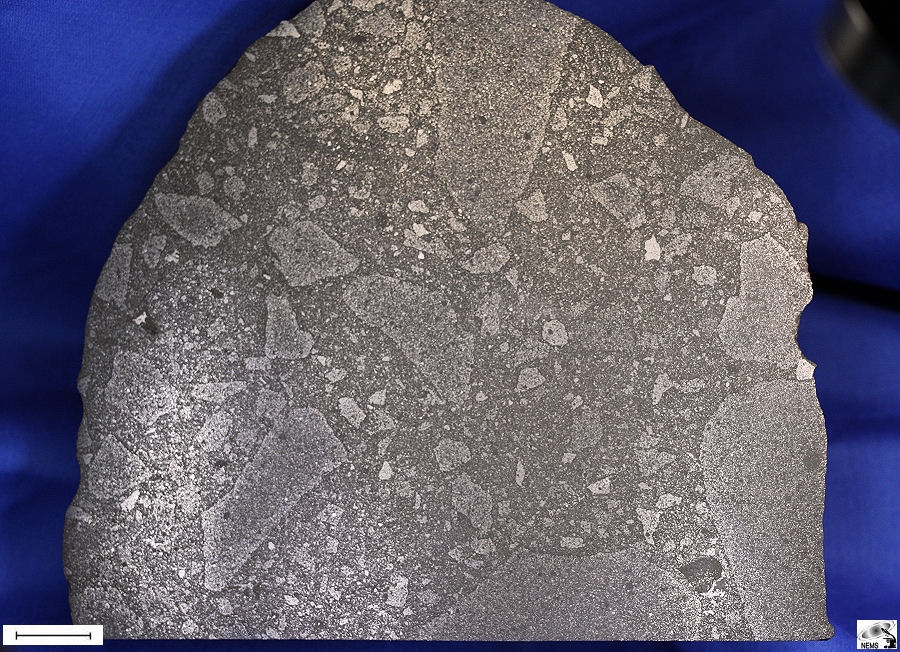
| Figure 1. Scale bar 1 cm. |
Abee, EH4, chondrite, impact-melt breccia. |
| Breccias, Impact, and Regolith in
Meteorites Figure 1. Abee (EH4) chondrite, impact-melt breccia. Scale bar=1 cm. Figure 2. Cangas de Onis (H5) chondrite, regolith breccia. Scale bar=4 mm. Figure 3. Bison (LL6) chondrite, regolith breccia. Scale bar=1 cm. Regolith Breccias Regolith breccias are lithified fragments of the unconsolidated surface debris (regolith) that blankets airless or minimally atmosphered bodies such as asteroids, the Moon, and Mars. Regolith forms through prolonged impact gardening—the repetitive comminution, mixing, and turnover of surface materials by meteoroid bombardment—producing a heterogeneous layer of rock fragments, mineral grains, dust, agglutinates, and glassy particles. Lithification into breccia occurs during subsequent impacts that deliver sufficient shock pressure and heat to compact and fuse the loose material, often with localized melting or sintering. These breccias are texturally complex and polymict, incorporating lithic clasts (rock fragments), mineral grains (some shocked, e.g., maskelynite from plagioclase), glassy spherules (impact-melt droplets quenched in flight), and occasionally projectile-derived material. A diagnostic feature is enrichment in solar-wind-implanted noble gases (He, Ne, Ar, Kr, Xe), acquired by surface grains during prolonged exposure to the solar wind—a stream of charged particles from the Sun. Isotopic signatures, such as elevated ³He or characteristic ²°Ne/²²Ne ratios, serve as indicators of surface residence time and distinguish regolith breccias from subsurface materials. Examples include the Cangas de Onis (H5) and Bison (LL6) ordinary chondrites, which preserve clastic textures and solar-gas signatures indicative of asteroidal regolith processing. Impact-Melt Breccias Impact-melt breccias form during high-energy collisions when shock waves generate extreme pressures and temperatures sufficient to melt significant portions of the target rock. The resulting melt incorporates and mixes with unmelted clasts before rapidly cooling and solidifying. Unlike regolith breccias, which rework pre-existing surface debris, impact-melt breccias often sample deeper crustal or mantle materials and record the instantaneous thermal and chemical effects of the impact event itself. The Abee (EH4) enstatite chondrite provides a classic example of an impact-melt breccia with distinctive textures reflecting partial melting and rapid crystallization. Impact-melt breccias generally lack significant solar-wind-implanted gases because their constituent materials were either derived from shielded subsurface depths or degassed during melting. Classification and Additional Breccia Types Breccias are further classified by clast diversity: • Monomict: Dominated by fragments of a single lithology • Polymict: Multiple distinct lithologies • Dimict: Two principal components • Genomict: Genetically related but texturally or chemically distinct clasts • Supplemental updates may expand on these variants Scientific Significance Regolith and impact-melt breccias provide complementary windows into planetary surface evolution. Regolith breccias chronicle long-term space weathering, impact gardening, and solar-wind exposure on airless bodies, while impact-melt breccias capture discrete, high-energy events. On the Moon, such samples have been instrumental in constraining the timing of the Late Heavy Bombardment (~3.8–4.1 Ga). In chondrites, they reveal the collisional and thermal histories of their parent asteroids, contributing to models of early Solar System dynamics and the delivery of volatiles and organics to terrestrial planets. . |
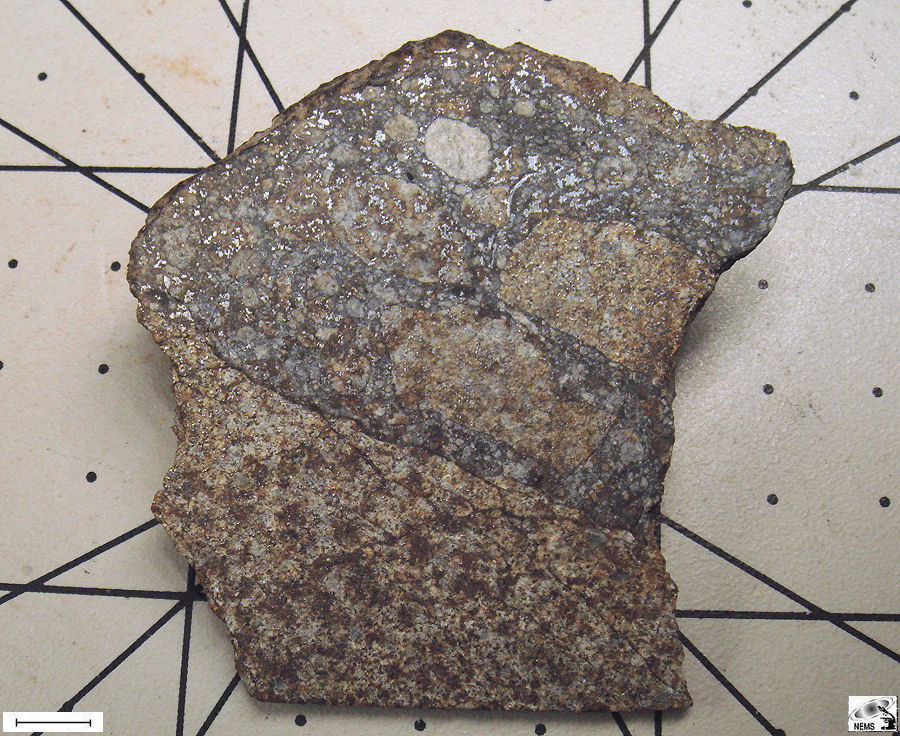
| Figure 2. Scale bar 4mm. |
Cangas de Onis, H5 chondrite, regolith breccia |
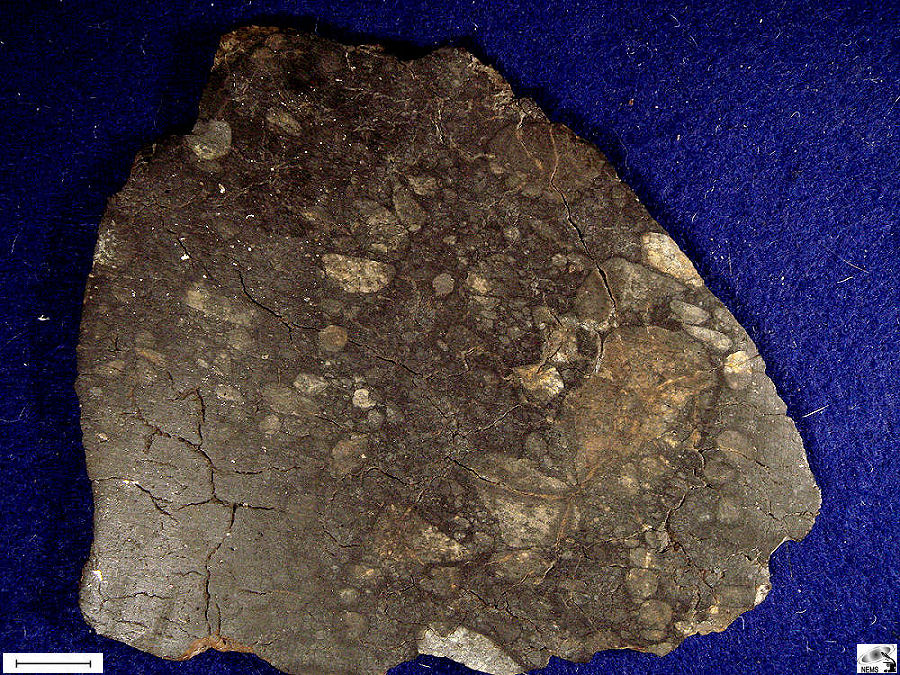
| Figure 3. Scale bar 1 cm. |
Bison, LL6 chondrite, regolith breccia |
| References • Rubin, A. E. (various works on chondrite breccias and personal communication, 2024). • Meteoritical Society resources and standard texts on regolith processes (e.g., lunar sample studies and asteroidal meteorite petrology). • Buchwald, V. F. (1975) and subsequent chondrite classification literature for specific meteorites like Abee, Cangas de Onis, and Bison |
| Listing of Structures |